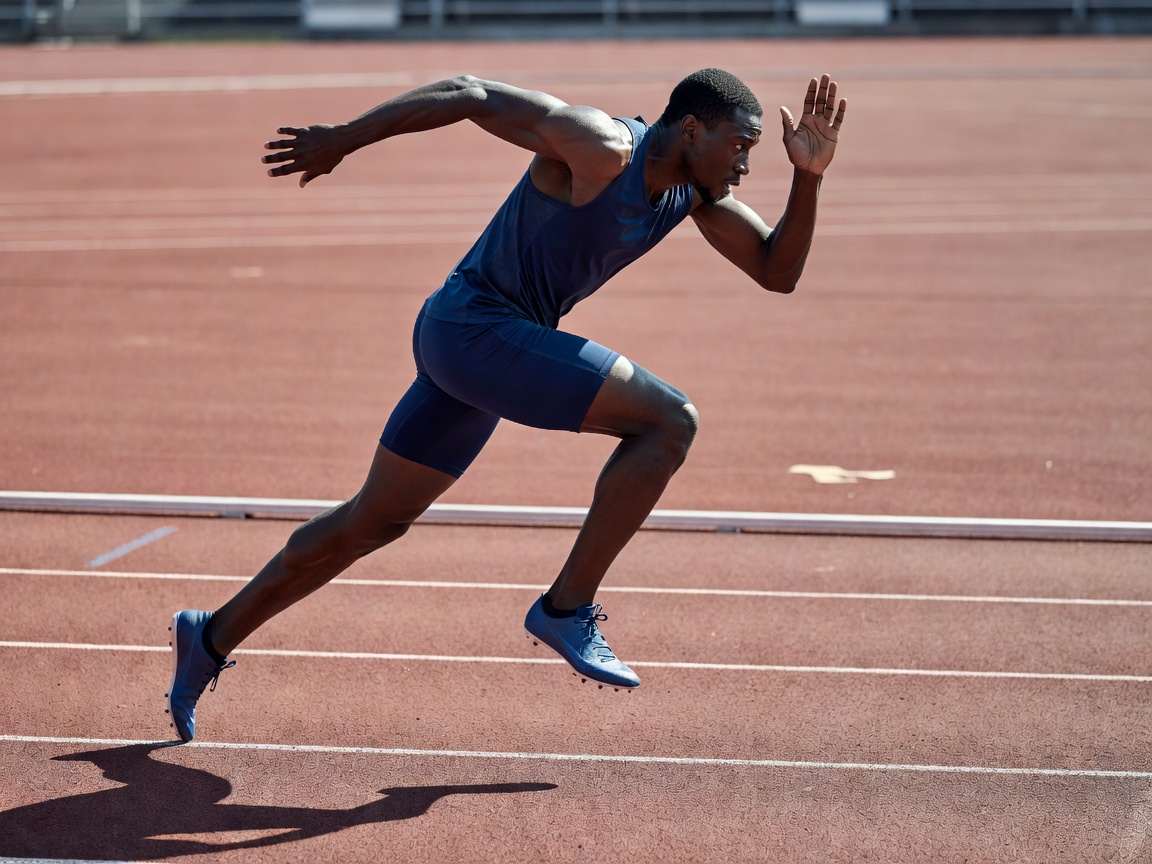
1. The Biomechanical Paradox of Maximal Speed
At elite levels, the differentiator between a 10.2s and a 9.9s 100-meter sprinter does not lie primarily in stride frequency or limb movement velocity during the swing phase. Rather, it is determined almost entirely by the magnitude of vertical and horizontal force applied to the track within an exceptionally constricted timeframe: less than 90 milliseconds (0.090s).
During upright sprinting, the foot contacts the ground with a horizontal velocity relative to the center of mass that approaches zero (the "clawing" or negative foot speed action). Any braking impulse generated by landing too far ahead of the center of mass dramatically increases ground contact time (GCT), bleeding kinetic energy.
2. Neuromuscular Rate of Force Development (RFD)
Because human muscle-tendon complexes take approximately 200–300 milliseconds to achieve peak voluntary isometric force, the sprint foot-strike window represents an extreme temporal deficit. An athlete cannot simply "muscle" their way through ground strike. They must rely on:
- Pre-Activation Tension: High electromyographic (EMG) firing in the gastrocnemius, soleus, and hamstrings 50ms prior to touchdown to prepare the lower limb for violent impact.
- Tendon Ankle Stiffness: High structural stiffness in the Achilles tendon complex to utilize passive elastic energy return rather than active concentric shortening.
- Pelvic Neutrality: Maintaining anterior-posterior pelvic stability to prevent energy leakage through excess lumbar extension.
| VARIABLE | SUB-ELITE RANGE | ELITE THRESHOLD | OPTIMIZATION MECHANISM |
|---|---|---|---|
| Ground Contact Time (GCT) | 0.115 - 0.135s | 0.080 - 0.088s | Ankle isometric stiffening & reactive plyometrics |
| Vertical Peak Force | 3.2x Body Mass | 4.8x Body Mass | Supramaximal drop jumps & accentuated eccentrics |
| Thigh Separation Angle | 38° - 42° | 48° - 54° | Iliopsoas high-velocity cable pulls |
3. Applied Laboratory Training Protocols
To condense ground contact duration while driving higher vertical impulses, coaches must implement high-load eccentric overload coupled with high-velocity shock methods:
Phase A: Ankle Complex Co-Contraction Isometrics
Single-leg isometric mid-thigh pulls with specific focus on rigid plantarflexion angle (90° dorsiflexion lock). 3 sets of 5 repetitions, holding each maximal effort contraction for 3.5 seconds.
Phase B: Overspeed Flywheel Assisted Runs
Utilizing motorized horizontal tether systems delivering 2.5kg to 4.0kg of gentle forward tow. This forces the athlete to coordinate limb repositioning at velocities 3-5% above their independent maximal capacity, driving central nervous system adaptation.